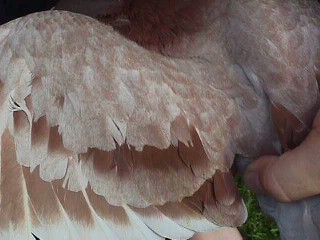
Your thoughts members.
Thanks gents. Interestingly, this is what a bit of A.I research found….
When breeding racing pigeons, the saying "never breed a mealy with a mealy" is not a strict rule but a guideline followed by some breeders to maintain genetic diversity and produce certain color patterns. A "mealy" pigeon is the term for an ash-red bar pigeon, which carries the dominant ash-red gene. Breeding two mealy pigeons can lead to less desirable color outcomes and a higher probability of producing less vigorous offspring, especially when inbreeding is involved.
Why some breeders avoid this pairing
While breeding two mealy pigeons doesn't guarantee poor results, some breeders avoid it for these reasons:
Aesthetics: To produce a variety of colors in their loft, breeders often prefer to pair a mealy (ash-red) with a blue/black bird, which can produce both ash-red and blue/black chicks, as ash-red is a sex-linked dominant trait.
Variety: Mixing mealy with a blue or black bird offers a broader spectrum of color results, such as blue bars, blue checkers, mealies, or red checkers.
Genetic diversity: The principle aligns with general good breeding practices of avoiding the pairing of similar types, colors, or traits to prevent the "doubling up" of undesirable recessive genes and maintain vigor.
When breeding racing pigeons, the saying "never breed a mealy with a mealy" is not a strict rule but a guideline followed by some breeders to maintain genetic diversity and produce certain color patterns. A "mealy" pigeon is the term for an ash-red bar pigeon, which carries the dominant ash-red gene. Breeding two mealy pigeons can lead to less desirable color outcomes and a higher probability of producing less vigorous offspring, especially when inbreeding is involved.
Why some breeders avoid this pairing
While breeding two mealy pigeons doesn't guarantee poor results, some breeders avoid it for these reasons:
Aesthetics: To produce a variety of colors in their loft, breeders often prefer to pair a mealy (ash-red) with a blue/black bird, which can produce both ash-red and blue/black chicks, as ash-red is a sex-linked dominant trait.
Variety: Mixing mealy with a blue or black bird offers a broader spectrum of color results, such as blue bars, blue checkers, mealies, or red checkers.
Genetic diversity: The principle aligns with general good breeding practices of avoiding the pairing of similar types, colors, or traits to prevent the "doubling up" of undesirable recessive genes and maintain vigor.
-
Anthony webster
- Posts: 1440
- Joined: Fri Apr 05, 2024 4:54 am

With the old lambrecht bill duckworth told me never to pair 2 reds together unless both were unbelievable racers and you was putting children to stock ,,he said for racing he paired blues or cheqs or darks to reds .
-
Anthony webster
- Posts: 1440
- Joined: Fri Apr 05, 2024 4:54 am
At bill duckworths sale martin n Watts from Essex bought liam and the best hen both red , I'm sure these 2 paired together didn't breed many winners they might of bred the thurso winner if I remember rightly for them Steve Foster bought these 2 pigeons of Martin n Watts and on bill duckworth advice split the pair n both birds bred a stack of winners n g children gg children ggg children still winning from these birds on bills advice.
So there’s the conflict in my head. Sounds like Bill Duckworth knows (or knew) his stuff, and he said the same as Lloyd is telling me now. Is it folklore or wisdom?Anthony webster wrote: Fri Nov 07, 2025 9:04 am At bill duckworths sale martin n Watts from Essex bought liam and the best hen both red , I'm sure these 2 paired together didn't breed many winners they might of bred the thurso winner if I remember rightly for them Steve Foster bought these 2 pigeons of Martin n Watts and on bill duckworth advice split the pair n both birds bred a stack of winners n g children gg children ggg children still winning from these birds on bills advice.

While it doesn't affect performance it will affect the birds colour. If you want to avoid 'washing out the birds colour' you should where possible avoid pairing light coloured birds together. The syndicate loft of birds is a good example, constant pairing cheq x cheq has washed the cheq pattern out of many of the birds to the extent many look like blues with a slight 3rd bar (but are genetically still cheqs)PeteDerby wrote: Fri Nov 07, 2025 8:11 am Thanks gents. Interestingly, this is what a bit of A.I research found….
When breeding racing pigeons, the saying "never breed a mealy with a mealy" is not a strict rule but a guideline followed by some breeders to maintain genetic diversity and produce certain color patterns. A "mealy" pigeon is the term for an ash-red bar pigeon, which carries the dominant ash-red gene. Breeding two mealy pigeons can lead to less desirable color outcomes and a higher probability of producing less vigorous offspring, especially when inbreeding is involved.
Why some breeders avoid this pairing
While breeding two mealy pigeons doesn't guarantee poor results, some breeders avoid it for these reasons:
Aesthetics: To produce a variety of colors in their loft, breeders often prefer to pair a mealy (ash-red) with a blue/black bird, which can produce both ash-red and blue/black chicks, as ash-red is a sex-linked dominant trait.
Variety: Mixing mealy with a blue or black bird offers a broader spectrum of color results, such as blue bars, blue checkers, mealies, or red checkers.
Genetic diversity: The principle aligns with general good breeding practices of avoiding the pairing of similar types, colors, or traits to prevent the "doubling up" of undesirable recessive genes and maintain vigor.
Neil. It's not as easy to explain in set colours blue, cheq, mealy ect. It's more colour strength. 1st bird light, 2nd bird Dark.NeilA wrote: Fri Nov 07, 2025 3:27 pm King what are light colour birds ?
Are blues light
Are mealy light and reds dark ?


A Pencil is not really a colour, the correct term is 'Sooty' The Sooty gene will smudge up the wing shield pattern. It causes barred birds to look like poor checkered ones. It called Strawberry by many on an Ash Red Mealys. Sooty can be used as a darkening factor to improve colour.